
As promised, Intel has launched the Core Ultra Series 3 processors at CES 2026. These are the long-awaited “Panther Lake” chips, and if Intel’s claims hold up under our own testing, they look incredibly impressive. Intel made some very big promises at the show: 24% improved multi-threaded performance versus its own Arrow Lake processors (despite having fewer P-cores), 50% better power efficiency than AMD’s Ryzen AI 300 series, and a whopping 73% better gaming performance against the competition. Let’s check out those claims with Intel’s slides.

This slide covers the high points of Panther Lake: up to 16 CPU cores in a 4+8+4 configuration, up to 96GB of LPDDR5 or 128GB of DDR5 DIMMs (with LPCAMM support and transfer rates up to 9600 MT/s), next-generation architectures for every single IP block, twelve Xe3 cores in the integrated GPU, and so on. We’ve actually already written at length about Panther Lake’s new technologies, so we’re not going to retread that ground; if you want the technical nitty-gritty, hit up our Panther Lake write-up from Intel’s Tech Tour 2025.
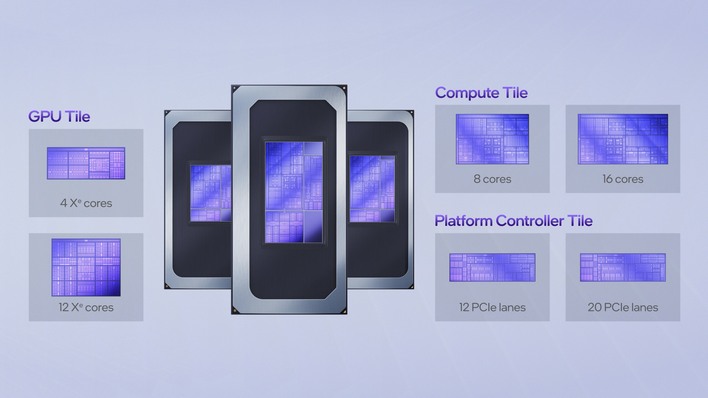
Instead, let’s talk about the specific configurations that Core Ultra Series 3 parts will come in, because it’s a bit of a mix-and-match processor design. Intel is fully realizing the benefits of tile-based architecture here, so it can build you a CPU with as few as six CPU cores or as many as sixteen, just four Xe3-cores or up to twelve, and twelve or twenty PCIe lanes depending on vendor preference. This is achieved by simply swapping out tiles, although it doesn’t look like there’s a configuration with few CPU cores and the big GPU tile.
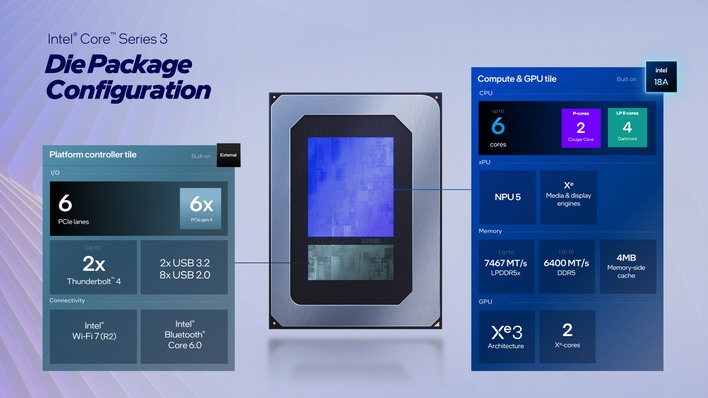
No matter which Panther Lake part you pick up, you’ll be getting Cougar Cove CPU cores and Darkmont E-cores, whether those are “standard” E-cores or “LP” E-cores optimized for low-power and standby operation. While the LP E-cores on Meteor Lake were of dubious utility, these appear to be more useful, as they’re active when the processor is awake and can contribute to multi-core performance.
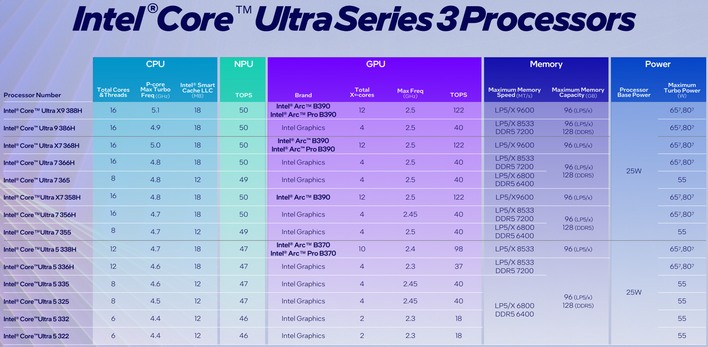
So, let’s check out the specifications on the specific SKUs. As was rumored, there are three models with “X” as part of the branding; the Core Ultra X9 388H, Core Ultra X7 368H, and Core Ultra X7 358H all come along with the “big” graphics tile, meaning they have real discrete-class graphics firepower thanks to twelve Xe3-cores running at up to 2.5 GHz. This is a configuration not too far from the Intel Arc B570 that we reviewed, which has 18 Xe2-cores running at the same 2.5 GHz.
The memory specs for these parts are a major jump from previous generations. In particular, the choice to use 9600 MT/s memory for the “X” parts with fast integrated graphics is a key strategic decision and likely plays a large part in Intel’s claims of mercilessly dunking on AMD’s Ryzen AI HX processors in gaming, as they are typically paired with slower 7500 or 8000 MT/s RAM.
All of the chips launching today are listed with 25W base power ratings, although the maximum turbo power creeps as high as 80W on the faster configurations. This isn’t surprising at all; Arrow Lake typically had turbo power ratings in the 125W range, so this is a fair bit lower. Despite that, Intel says Panther Lake is faster than Arrow Lake in multi-threading, and we’ll take a look at that on a second, but first let’s peek at Intel’s efficiency claims.
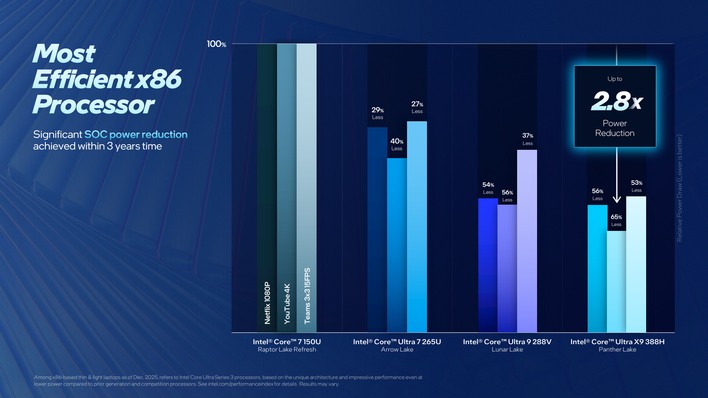
Intel’s power efficiency claims mostly target its three-year-old Core 7 150U processor, as the needle hasn’t really moved all that much since Lunar Lake. Even still, the new chips do seem to beat Lunar Lake in power efficiency, which is impressive given those parts’ use of on-package memory. In video streaming applications, Intel claims to have cut power by 53% compared to Raptor Lake, and what looks like around 10-15% on average versus Lunar Lake. Good stuff.
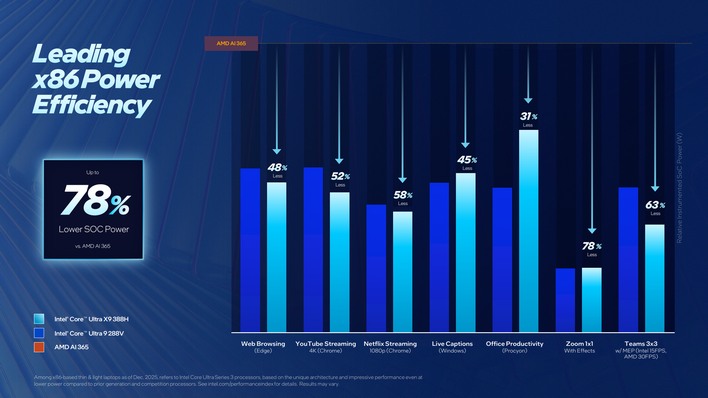
Intel brazenly compares its chips new and old against AMD’s Ryzen AI 7 365 processor, claiming as much as a 78% reduction in power usage versus the competitor’s part. It hasn’t really floated to the surface in the face of the performance story, but Intel’s been dominating power efficiency for a few generations now, so this isn’t super surprising. It’s good to see Panther Lake generally keeping pace with Lunar Lake despite having a larger GPU, more CPU cores, and off-package memory, though.
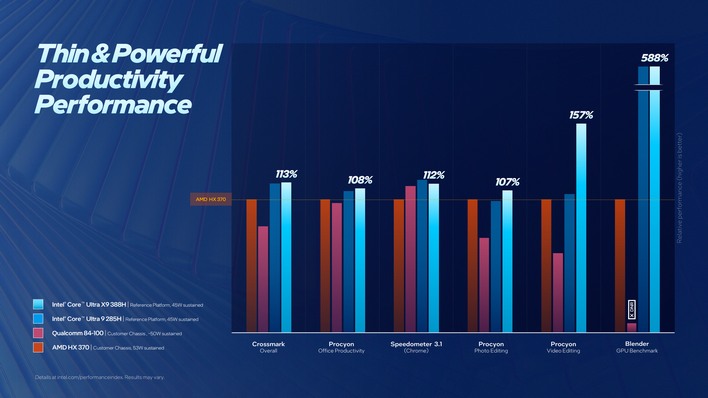
Panther Lake is arguably a successor to Lunar Lake, yet those extra cores are what’s allowing Intel’s new parts to keep pace with even the Core Ultra 200H series processors that feature up to 6 P-cores. In fact, by Intel’s own reckoning, the Core Ultra X9 388H pulls out narrow victories against the previous-generation chips in everything besides Speedometer. It also purportedly crushes AMD and Qualcomm in these tests at ~45-50W.

Testing at 25W (and swapping out the Qualcomm chip for a Lunar Lake 288V), performance scaling is actually even more impressive, with the new part handily beating everything else in Intel’s productivity test suite. Including Blender is almost not even fair; Radeon GPUs have struggled in Blender since time immemorial. It’s impressive that Intel has gotten it working so well on Arc, though.
Panther Lake Promotes GPU Performance Far Beyond Previous-Gen Parts

Someone thinks they are very clever for that pun, guaranteed.
On stage, Intel went over its “Arc of Innovation” with the Arc GPU brand since its inception in 2021. It’s been quite a ride so far, and while there’s plenty of critique we could make with a historical perspective, it’s undeniable that Intel has ended up in a pretty decent position with its Arc GPUs.
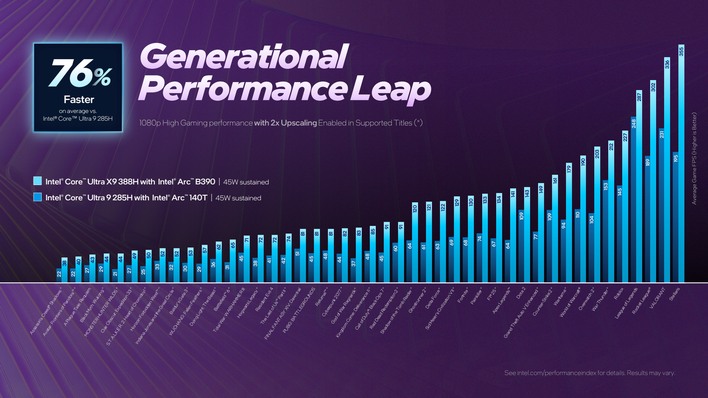
Intel describes the performance of the Arc B390 GPU in the Core Ultra X9 388H as a “generational performance leap”, and it’s hard to argue given the numbers on offer. Comparing the Core Ultra X9 388H against the Core Ultra 9 285H, the new part comes out 76% faster on average, and in some cases that means turning a 30 FPS experience into a 60 FPS one. Note that this list includes current games, like Dying Light: The Beast and Assassin’s Creed Shadows; these are demanding titles on High settings. Impressive stuff.
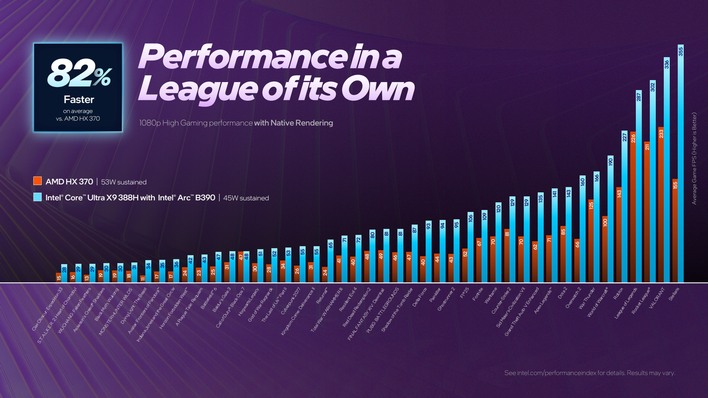
Intel compares its new part against AMD’s Ryzen AI 9 HX 370, too, which was well understood to offer comparable performance to Intel’s Lunar Lake. In Intel’s test suite, it claims to be 82% faster on average versus AMD’s Strix Point, and this chart is using native rendering, unlike the above. Native 1920×1080 resolution with “High” settings is a big ask in most games for integrated graphics, so to see Intel putting up over 60 FPS in titles like Returnal, Resident Evil 4 Remake, and the new Painkiller reboot is outstanding.
There’s another slide where Intel absolutely dunks on Qualcomm, but the Arm chip didn’t even complete most of the benchmarks, so let’s just skip it and move on.
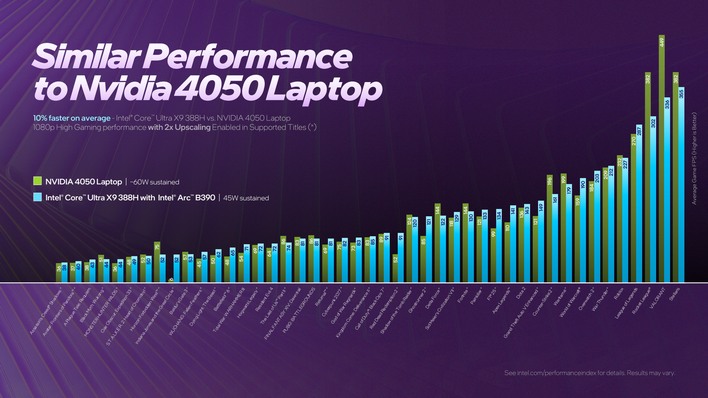
Finally, Intel compares its new integrated GPU to NVIDIA’s smallest Ada Lovelace GeForce, and it comes away with a 10% performance advantage, at least by Intel’s own reckoning. Large performance advantages for NVIDIA in eSports games like Valorant and Rocket League are offset by huge Intel advantages in titles that are constrained by video memory limits, including Red Dead Redemption 2 as well as Indiana Jones and the Great Circle.
This comparison is all the more impressive considering that we’re comparing an SoC with a shared 45W power limit against a discrete GPU with an exclusive 60W power budget. While the absolute performance isn’t outstanding in either case—both are decidedly entry-level GPUs—Intel’s part is clearly doing much more work per watt, making it the obvious choice for gamers on the go (assuming these numbers hold up in third-party testing, like ours.)


Of course, we can’t have new Arc GPUs without an update on XeSS. This release comes along with XeSS 3, now featuring everyone’s favorite gaming feature, Multi-Frame Generation (MFG). That’s right: if your game is running poorly, you too can now at least pretend that it’s running well by generating up to three AI hallucinations for every real rendered frame. Hurray.
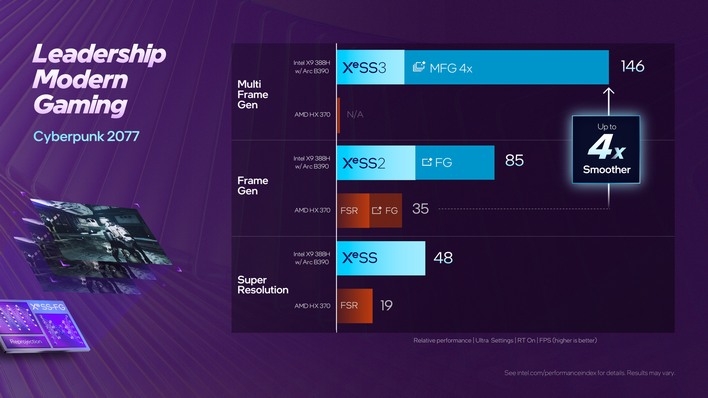
In Cyberpunk 2077 with RT Ultra settings, it’s no surprise that Intel’s Xe3 architecture delivers a beatdown on AMD’s RDNA 3.5 in the Ryzen AI 9 HX 370. 48 FPS is right on the edge of where we’d accept using frame generation, so this result is plausibly acceptable, although we’re not terribly impressed with the comparison against AMD; it’s a bit like beating a one-legged man in a two-legged race.

The comparison against NVIDIA is a bit more salient; the Arc B390 seems to handily beat NVIDIA’s baby GeForce in this test, and that’s pretty cool both because of the power efficiency differential we talked about above and also because Cyberpunk 2077 with ray-tracing is absolutely NVIDIA’s home turf. Xe2 was already strong with ray-tracing, and it looks like Xe3 might improve on it further still. Of course, the point Intel is making here is that NVIDIA doesn’t allow MFG on RTX 4000 GPUs.
All told, this is a stunning GPU performance uplift, and we can’t wait to get our hands on handheld machines with these chips. We already loved the MSI Claw 8 AI+ with Lunar Lake, and it’s looking like the next generation Claw machine may just be even more powerful. Intel says it has a whole “handheld gaming platform” launching later this year, but didn’t share any more details, so look out for that in the coming months.
Intel’s All In On Local AI

Of course, Intel couldn’t launch a new product in 2026 without talking about its AI performance at tremendous length. We’re going to skip over most of the marketing for you—350+ ISVs, 500+ AI features, 900+ models supported—and get to the interesting stuff.
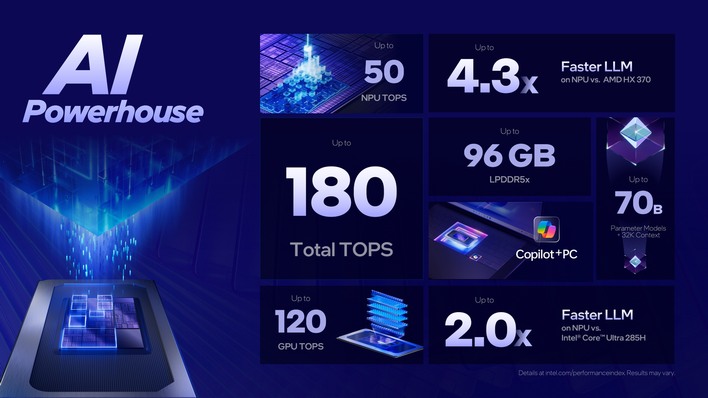
This slide sums up AI performance on Panther Lake: up to 180 total TOPS, with 120 of that coming from the GPU and another 50 coming out of the NPU. Intel says that despite a similar “TOPS” rating, its NPU can perform LLM inference 4.3 times faster than AMD’s XDNA2 NPU abord the Ryzen AI 9 HX 370, and that it doubles the speed of the NPU on the Core Ultra 9 285H—which we’d hope, considering that was the aged NPU3 architecture.
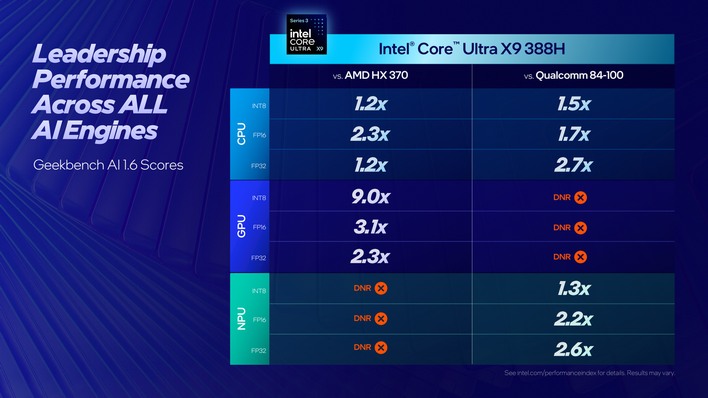
Intel emphasizes the idea that it’s the only laptop vendor currently treating all three compute engines—CPUs, GPUs, and NPUs—as first-class citizens, with “leadership performance” on every test in Geekbench AI against AMD and Qualcomm chips.
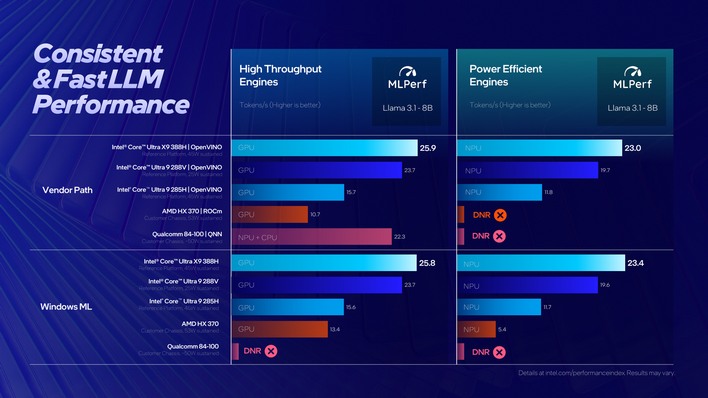
The company also presents MLPerf inference performance tests that compare the tokens-per-second throughput of its parts against AMD’s and Qualcomm’s on both GPUs and NPUs, using both the vendor-specific and Windows ML-based codepaths. NPU support on both AMD and Qualcomm platforms can be a little sketchy still, so it’s no surprise that Intel walks away with those results, but the GPU scores are also impressive.
Intel’s Coming For Edge Computing With Core Ultra Series 3
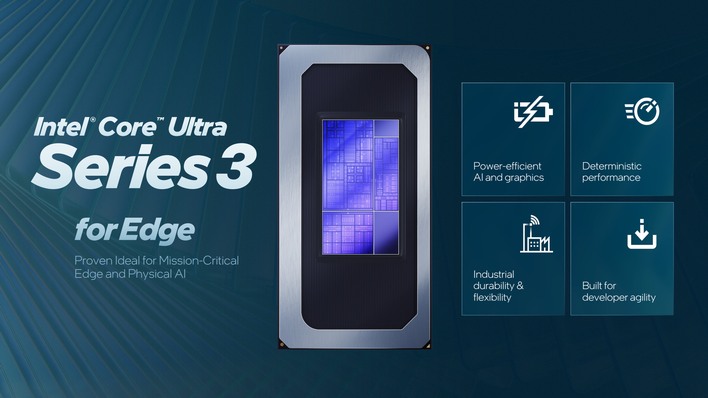
Interestingly, where Intel historically sticks to older product lines for its networking and edge segment, it’s bringing Core Ultra Series 3 directly to the edge market immediately, targeting fields like automotive, medicine, and robotics, where it hasn’t had a strong presence in the past.
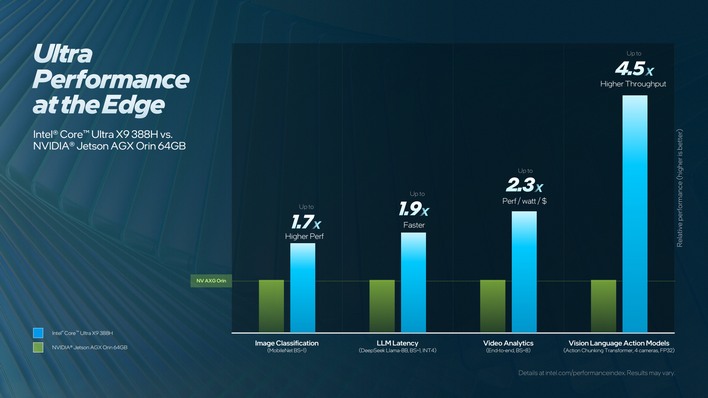
Intel compares the new Core Ultra X9 388H against NVIDIA’s four-year-old AGX Orin kit and naturally, comes out way ahead, although we’d certainly hope so. AGX Orin is popular in robotics applications, so the benchmarks in question (Image Classification, LLM Latency, Video Analytics, and Vision Language Action Modeling) are targeted specifically at that niche. Intel’s actually got an AI-powered humanoid robot demo at the show; we’ll see if we can get a photo of it.

Comparing against AMD’s latest and greatest, Intel finds the Red Team… wanting. Seriously, though, the scores for these benchmarks against AMD’s monster Ryzen AI Max+ 395 processor are very impressive, and likely the result of software optimizations Intel has been tirelessly plugging away at in hopes of beating NVIDIA on efficiency if not in raw performance.
Intel’s 18A Process Is Firing On All Cylinders
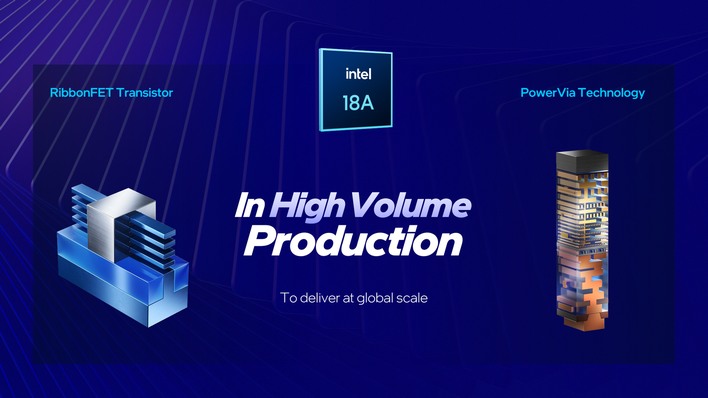
Arguably, the even bigger news than Panther Lake itself concerns the process that the Core Ultra Series 3 parts are built on: Intel’s 18A. Intel described it on stage as “the most advanced silicon manufacturing process in the world,” and it’s hard to argue; right now, only Intel has both GAAFETs and back-side power delivery in working silicon.
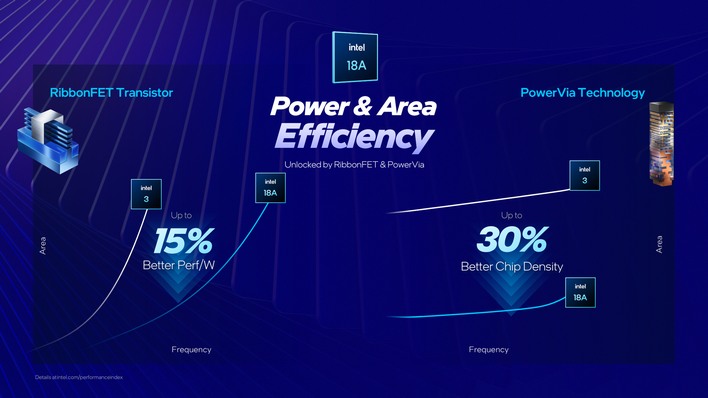
Intel credits the 18A process with a 15% gain in efficiency and a 30% gain in density versus its previous-generation Intel 3 process. No doubt those process gains are a huge portion of the performance and efficiency uplift Intel is claiming over Arrow Lake and Lunar Lake.

Intel says the Core Ultra Series 3 parts are in high-volume manufacturing right now, and it’s clearly confident that it can supply the chips, because Intel also says it has over 200 system designs on the way sporting the new SoCs. From laptops, to mini-PCs, to tablets, to industrial computers, Panther Lake is going to pop up everywhere.
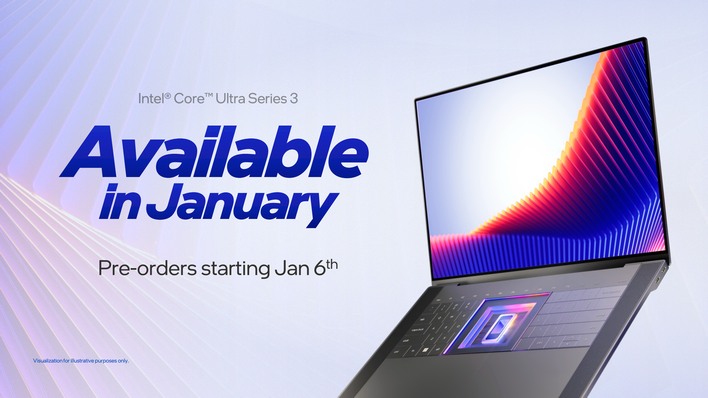
“But when?” you may be asking. Well, Intel says pre-orders are starting tomorrow, and that the machines should be shipping out this month. We’ll be taking a look at many Panther Lake-powered laptops over the next couple of days at CES, and we’re expecting to get a few review units in, too. Stay tuned to HotHardware for fully independent benchmarks on retail hardware before you know it.